
Hermitage Mews recognised by Historic England as an exemplar of net-zero infill housing
Gbolade Design Studio’s award-winning Hermitage Mews has been featured in a major new report examining how London can deliver new homes while strengthening the character, heritage and environmental performance of its neighbourhoods.
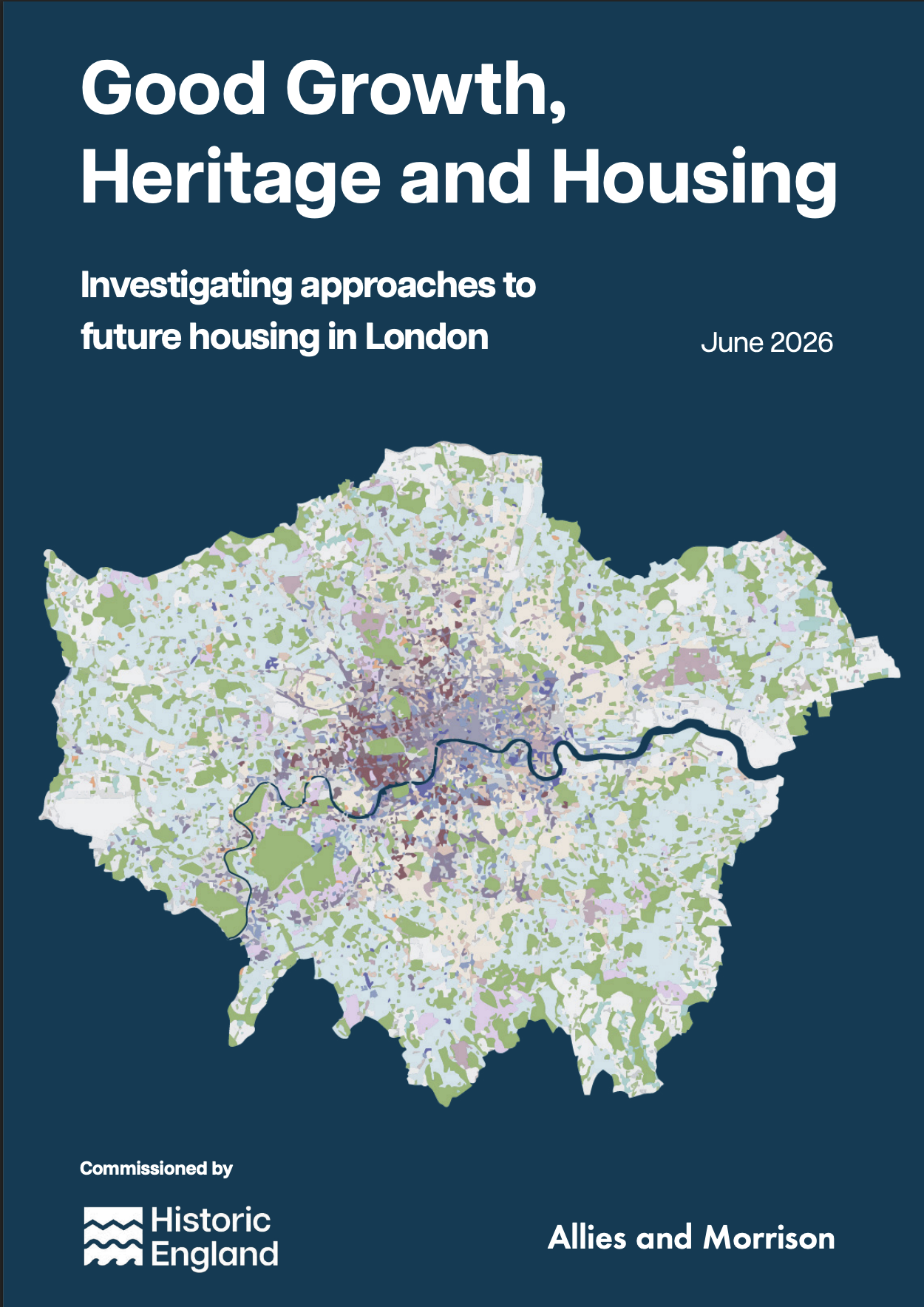
Published by Historic England in June 2026, Good Growth, Heritage and Housing: Investigating Approaches to Future Housing in London presents a framework for accommodating housing growth through adaptive re-use, sensitive intensification and contextual transformation. The research was prepared by Allies and Morrison for Historic England in response to London’s ambition to deliver 880,000 additional homes over the next decade.
A model for sensitive intensification
Hermitage Mews is included among the report’s completed examples of sensitive intensification, within its examination of recurring opportunities to unlock housing on underused urban land.
The project is specifically identified as an example of “delivering net-zero infill”, alongside a carefully selected group of housing schemes demonstrating how new development can increase density while responding intelligently to its surroundings. The report credits Gbolade Design Studio as architect, Placemakers London as client and GDS for the project photography.
Located in Crystal Palace, Hermitage Mews transforms a narrow, steeply sloping gap site into eight fossil-fuel-free townhouses. Rather than treating the site’s constrained geometry, topography and established landscape as obstacles, the design uses them to generate a distinctive and highly contextual residential environment.
A fabric-first energy strategy, photovoltaic panels and mechanical ventilation with heat recovery substantially reduce operational energy demand. Existing trees were retained wherever possible, supported by new planting, green roofs and measures designed to strengthen local biodiversity.
The result is a compact development that demonstrates how technically demanding small sites can contribute meaningfully to housing delivery without sacrificing environmental performance, residential quality or local character.
Small sites with wider relevance
The report argues that London’s housing challenge cannot be addressed through a single development model. While strategic regeneration will remain important, smaller interventions collectively represent a significant opportunity to intensify established neighbourhoods.
Hermitage Mews illustrates this principle in built form: a residual site has become a considered piece of neighbourhood, delivering new family homes while reinforcing the scale, grain and landscape qualities of its setting.
Tara Gbolade, Director of Gbolade Design Studio, said:
“Hermitage Mews demonstrates that constrained urban sites should not be regarded as leftover land. With sufficient design intelligence, they can support ambitious, low-energy homes that respond carefully to their neighbours and contribute positively to the wider character of the area.
“We are proud that Historic England and Allies and Morrison have included the project as part of this important discussion about how London grows. Its inclusion reinforces our belief that sensitive intensification and net-zero design must be pursued together, rather than treated as competing objectives.”
The feature follows wider recognition for Hermitage Mews, including winning the Housing Project category for schemes under £10 million at the 2024 AJ Architecture Awards and being shortlisted for the 2025 Housing Design Awards.
For GDS, its inclusion in Good Growth, Heritage and Housing provides further evidence that small, place-specific projects can offer replicable lessons for the future of sustainable housing across London and beyond.
The full document can be viewed here: Link
