
Unlocking Value Through Design-Led Planning
Gbolade Design Studio was appointed by a private developer to assess and unlock the redevelopment potential of an existing building on The Borough, a prominent former Barclays Bank building at the edge of Farnham Town Centre Conservation Area. Vacant town-centre assets of this nature present a familiar challenge for private developers: balancing heritage sensitivity, policy compliance and commercial viability, while minimising planning risk and programme uncertainty.
Our role focused on early-stage feasibility, pre-application engagement, and full planning submission, using a design-led and policy-informed approach to establish a robust planning strategy from the outset. Through detailed analysis of local and national planning policy, heritage constraints and housing need, we demonstrated that the existing building could accommodate a high-quality mixed-use scheme delivering six new residential units above retained commercial space at ground floor.
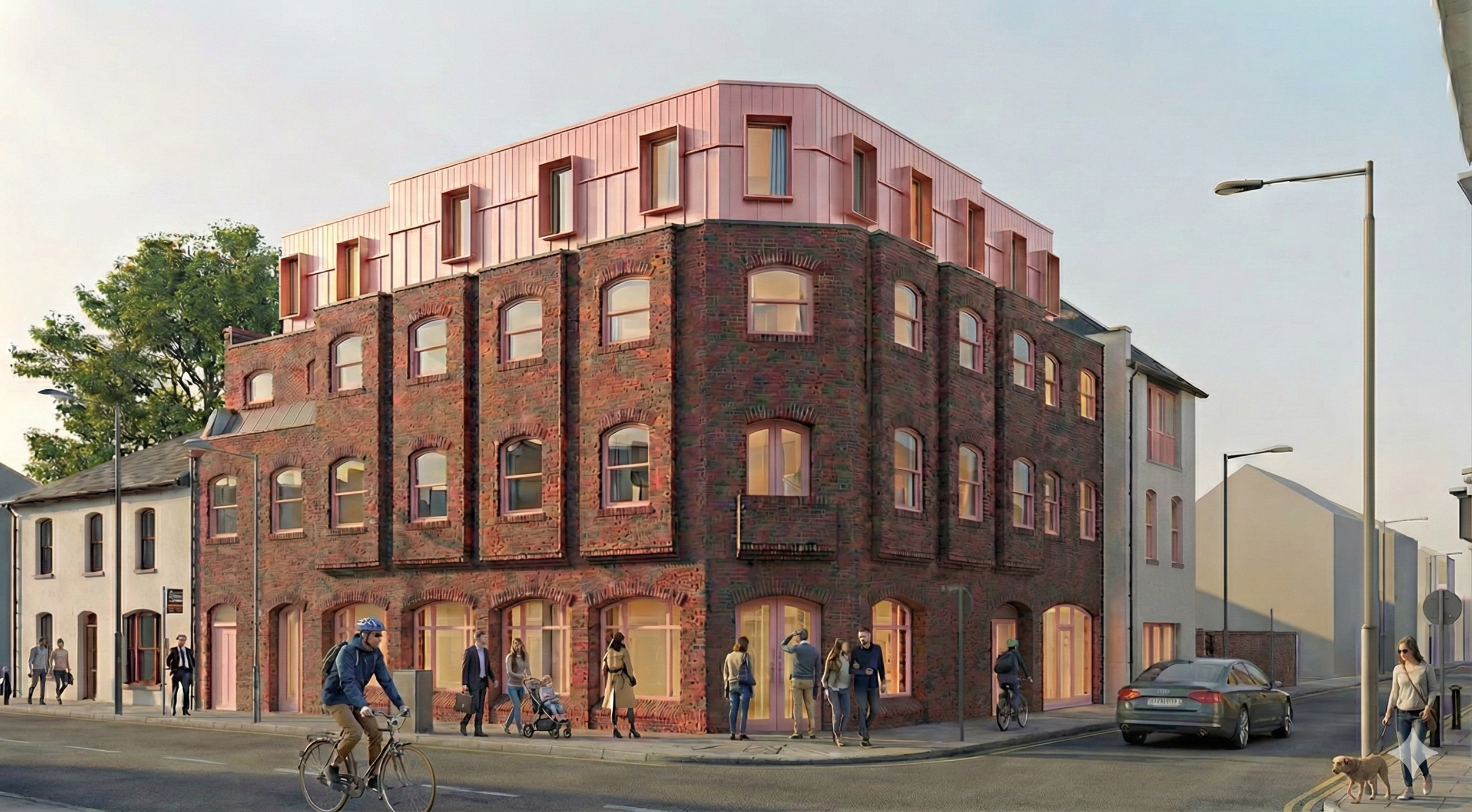
A key component of the proposal is a carefully calibrated upward extension. The new top floor is conceived as a lightweight, recessive addition, deliberately set back from the principal façades and expressed in a contemporary light-pink metal cladding. This approach ensures the extension reads as a clear yet subordinate layer, visually distinct from the retained red-brick building below. The set-back reduces perceived height at street level, preserving established cornice lines and minimising impact on key views along The Borough and South Street. The roof form follows the geometry of the existing corner plot, allowing the extension to sit comfortably within the townscape while enabling the delivery of high-quality residential flats without increasing the original footprint. By following the geometry of the corner plot and retaining the existing footprint, the scheme maximises residential yield while minimising heritage impact — a critical factor in securing officer and stakeholder support.
From a planning perspective, this strategy aligns strongly with national and local guidance on upward extensions in sensitive town-centre locations: maximising housing delivery on previously developed land, while safeguarding heritage significance and streetscape legibility.
The existing façades are enhanced through comprehensive window replacement, introducing a consistent, high-quality fenestration system aligned with the building’s established rhythm and proportions. This improves daylight, energy performance and residential amenity, while resolving the fragmented appearance of the existing elevations. At ground floor, active commercial use is retained, supporting town-centre vitality and footfall, with all upper floors dedicated to residential use to provide clear functional zoning.
From a delivery perspective, the scheme demonstrates how early investment in design intelligence saves time and cost later in the process. By testing massing, unit mix and heritage impact upfront, we reduced planning risk, avoided abortive design work, and provided the client with a clear, evidence-based route to planning. The re-use of the existing structure further supports programme certainty and embodied carbon reduction.
