
Unlocking Small-Site Affordable Housing through Design-Led Intensification
Neave Close, Walpole is a small-site affordable housing redevelopment delivered for Flagship Housing Group, demonstrating how constrained rural plots can be intensified responsibly while enhancing place quality, accessibility and long-term operational performance. The scheme replaces two obsolete earth-sheltered dwellings with four new, fully accessible bungalow homes, responding directly to local housing need and policy priorities for rural affordability.
From the outset, the project was shaped around a clear housing-association brief: maximise the number of compliant homes on a challenging site while maintaining viability, meeting planning policy, and delivering homes that are adaptable over a lifetime. Through early feasibility testing and close engagement with East Suffolk Council via pre-application, the design team established that four single-storey dwellings represented the optimal balance between density, character and deliverability. Officer feedback directly informed the evolution of the layout, resulting in a refined scheme that improved daylight, privacy, parking accessibility and communal amenity.
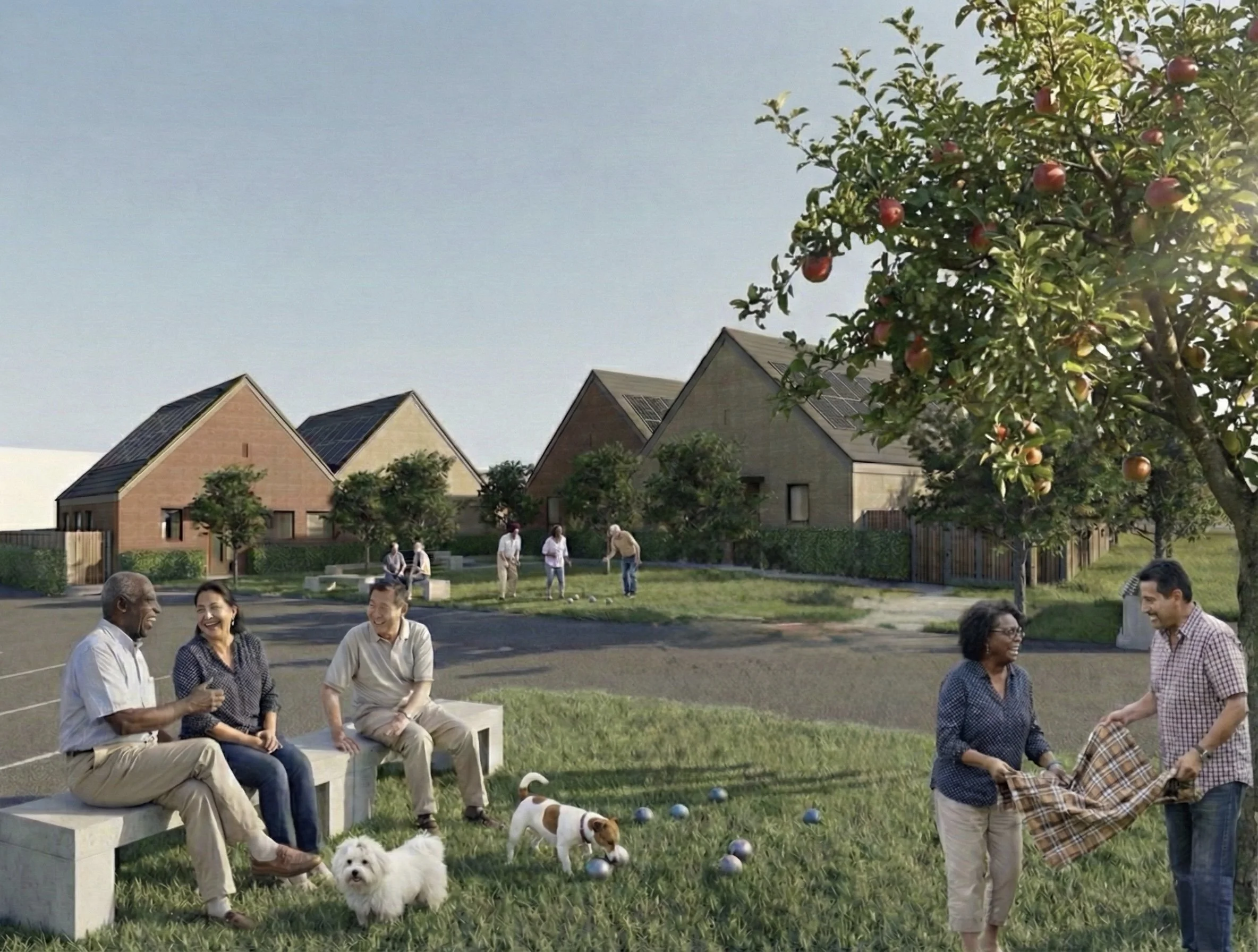
The final proposal delivers four 2-bed bungalows (M4(2) compliant), arranged as two modest semi-detached groups set around a shared arrival green. All homes benefit from private rear and side gardens, level access, secure cycle storage and dedicated parking positioned to support natural surveillance and ease of use for older or mobility-impaired residents. A central landscaped space with seating provides informal social value, reinforcing community cohesion without compromising residents’ privacy.
Sustainability and long-term asset performance are embedded through a fabric-first, passive design approach. Homes are orientated to maximise natural daylight and solar gain, while air-source heat pumps, permeable paving and sustainable drainage systems reduce both operational carbon and future maintenance liabilities. The landscape strategy mitigates tree loss, introduces new planting and supports biodiversity net gain—aligning with emerging environmental expectations placed on registered providers.
Critically, Neave Close illustrates how housing associations can unlock underperforming or constrained landholdings through robust design, early planning engagement and typology-led thinking. The project demonstrates a repeatable model for rural exception sites and small infill plots: increasing unit yield, improving accessibility standards and de-risking planning outcomes, while delivering homes that are socially sustainable, operationally efficient and well-loved by residents.
